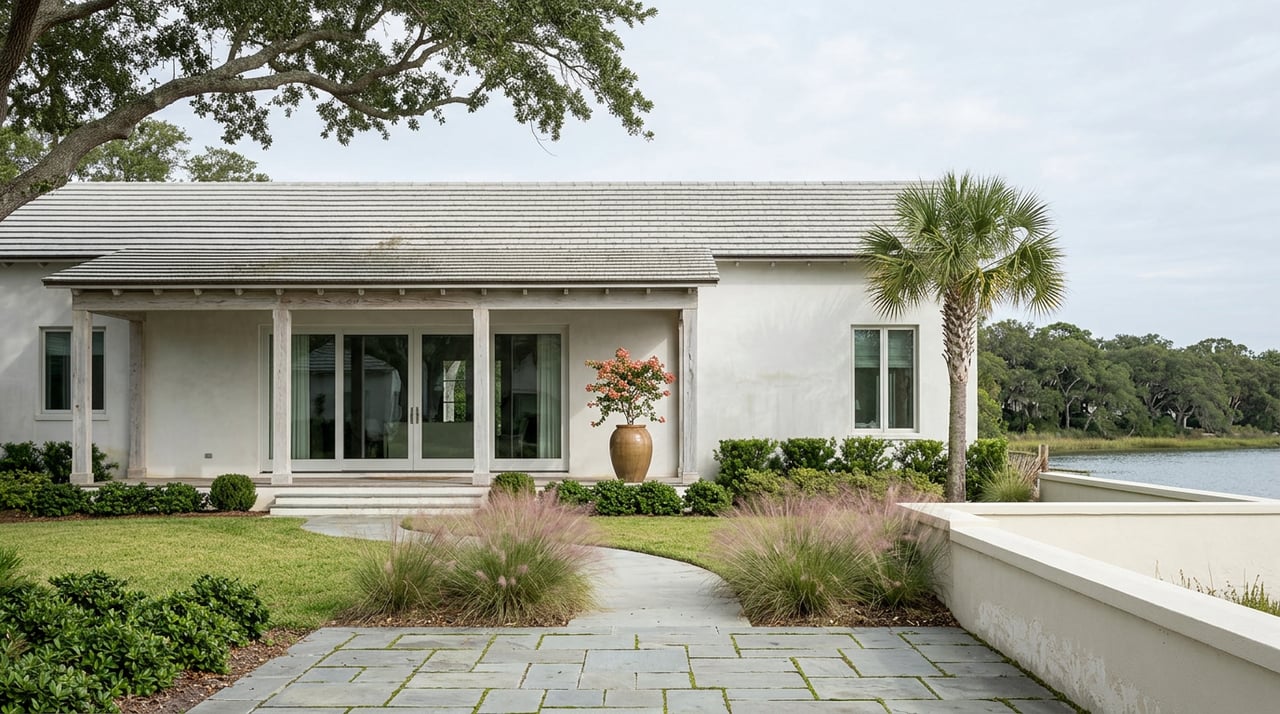
Why Lassing Park in Driftwood, St Petersburg Draws Locals
September 3, 2026
September 3, 2026
A little before sunset, the grass strip at Lassing Park fills up with people staring at their phones. They are not checking email. They are checking wind direction and tide height, because in Driftwood that is the actual weather forecast that matters. A stiff breeze out of the east means gear gets unpacked. A dying tide means it stays in the bag. Anyone who has lived along Beach Drive SE for more than a season reads this without thinking about it. Anyone new to the neighborhood usually has to be told twice.
Here is the part that surprises people who move to the water expecting a swimming beach: the sign at Lassing Park says you cannot swim there, and the city actively tracks the water quality to prove why. That same shallow, grassy, sandbar-protected stretch of Big Bayou that makes it a poor place for a swim is exactly what makes it one of the more forgiving wind-sport launches on this side of Tampa Bay. The limitation and the appeal are the same physical feature. Understanding that is the difference between treating Lassing Park as a pretty view at the end of the street and actually using it the way Driftwood residents do.
St. Petersburg's own parks department lists Lassing Park at 14.2 acres, notes that swimming is not permitted at the beach, and directs residents to check current testing results at stpete.org's recreational water quality page before getting in. That is not a bureaucratic footnote. It reflects what the water actually is: shallow, mixed with seagrass and sand, and sitting behind a sandbar that keeps Tampa Bay's chop from ever fully reaching shore.
Those are terrible conditions for lap swimming. They are close to ideal for anyone on a kiteboard, a wind wing, or a windsurfer. Watersports guides that track launch spots around the city describe Lassing as one of the flattest pieces of water in the bay on an east wind, protected enough that instructors consider it beginner-friendly and safe for teaching, according to Elite Watersports' guide to the spot. The same sandbar that would frustrate a swimmer trying to get past the shallows is what breaks up the waves before they reach the launch area. The bottom that would bother a barefoot beachgoer, with its shells and grass, is a non-issue if you are wearing water booties and staying on a board. Driftwood did not get a swimming beach. It got something else, and the something else turned out to be more useful to more people, more often.
The park only performs on certain days, and knowing which ones is the actual local skill. East-family winds work here: due east is best, with northeast and southeast also usable, though the surrounding land breaks up those angles enough to soften the pull compared to a straight easterly. Tide matters just as much. Too low and the water disappears entirely, leaving nothing to launch into, so anyone checking conditions is watching the tide chart as closely as the wind forecast before deciding whether to load the car.
| Wind Direction | Tide Condition | What You Get |
|---|---|---|
| Due east | Not low tide | Flat, forgiving water, described by local guides as some of the flattest in the bay |
| Northeast or southeast | Not low tide | Workable, but land shadow softens the pull compared to due east |
| Any direction | Low tide | Water can vanish, session is off regardless of wind |
| West or south-family winds | Any tide | Skip Lassing, look elsewhere in the bay |
That last row matters as much as the first. Lassing is not an every-day park for wind sports, and residents who fish or paddle there know its rhythm well enough to plan a Tuesday evening around it rather than a Saturday one, since wind and tide rarely cooperate on a fixed schedule.
For anyone hoping to string together a longer session, the run from Lassing Park north to the Sunshine Skyway's east launch is a known downwind route among the local wind-sport crowd, one that only works when conditions at the starting point are already dialed in. It is a small example of how one park's microclimate connects to a much larger stretch of the bay.
Lassing sits directly against a residential street, and the culture around it reflects that. Riders are expected to set up on the grass, not the road, and to stay clear of the power lines that run along the launch area. Homes line the water on the park's southern half, and the unwritten rule is to give them room rather than riding the shoreline close. None of this is posted on a sign. It gets passed along the way most neighborhood norms do, by watching what everyone else already does.
There is a lighter side to this local knowledge too. Longtime visitors warn newcomers about fire ants in the grass near the launch, a detail that shows up in resident reviews more than any official park guide. It is a small thing, but it is exactly the kind of detail that separates someone repeating a generic description of "a waterfront park" from someone who has actually set a bag down in the wrong spot once and won't do it again.
Lassing Park is the anchor, but it is not the whole picture. Frank Pierce Recreation Center and Bartlett Park sit nearby, along with the St. Petersburg Tennis Center for anyone whose version of an evening routine involves a racket instead of a kite. Grandview Park's boat ramps give access to Big Bayou and Salt Creek for anyone launching a kayak, paddleboard, or small boat rather than gear that needs wind. Big Bayou connects directly to the open water of Tampa Bay, and that same stretch shapes the daily rhythm for anyone who just wants a quiet paddle before work as much as it does for the boat owners who use it to reach the bay without a bridge in the way.
Driftwood is not a large place. Census figures cited by neighborhood platforms put the population at roughly 945 residents, and the district itself is bounded by 24th Avenue SE and Driftwood Road S, stretching from Florida Avenue S to Beach Drive SE. An arched metal sign marks the entrance, the kind of detail that makes the neighborhood feel more like a discovery than a drive-through.
Many of the original homes date to the 1920s through the 1950s, with a number attributed to local architect Mark Dixon Dodd, whose Italian Mediterranean style still defines much of the housing stock along the winding streets. St. Petersburg's City Council reconfirmed the neighborhood's local historic district status in 2019 after a contested process, a designation covered at the time by the Tampa Bay Times, and the district's protections remain part of what shapes renovation and construction decisions for homeowners here today. Groups like Preserve the 'Burg continue to document the neighborhood's history as part of that ongoing preservation effort.
The oak canopy that lines those streets does more than provide shade. Bat houses hang from several of the trees, and night herons are a regular sight along the water's edge, part of what longtime residents describe as the neighborhood's natural habitat as much as its architecture. The area's history runs deeper than the trees, too. Local accounts describe Driftwood as the only site in Pinellas County to see armed conflict during the Civil War, and periodic archaeological digs in the neighborhood have turned up items ranging from a shell fort believed to have been used by Native Americans to a Civil War-era cannonball and prehistoric stone tools. During Prohibition, the area's quiet waterfront reputedly made it useful to bootleggers moving goods along the bay, adding one more layer to a neighborhood that keeps surfacing new details the longer you pay attention.
None of these facts change how the wind blows at Lassing Park tomorrow evening. But they explain why residents talk about the neighborhood the way they do, less like an address and more like a place with its own memory. Reading the tide chart before a session and knowing the story behind the arched sign at the entrance turn out to be the same instinct: paying attention to a small place closely enough that it stops being generic and starts being yours.
If you are already living this rhythm in Driftwood and want a market perspective grounded in the same level of detail, from what the historic district designation means for renovations to how waterfront access shapes value on Big Bayou, Hilary O'Brien works this stretch of St. Petersburg regularly and is glad to talk through it. Schedule a free consultation whenever you are ready for that conversation.
This article is general information, not legal, tax or financial advice. Consult a qualified professional about your situation.
Stay up to date on the latest real estate trends.


Whether you’re buying, selling, or exploring your options, I’m here to help you move forward with confidence.